Steel Coil Importers & Distributors
Local & International GP
CRC-HRC-GP-ZAM-HESHE-PPGI
Steel Coil Importers & Distributors
Local & International GP
CRC-HRC-GP-ZAM-HESHE-PPGI
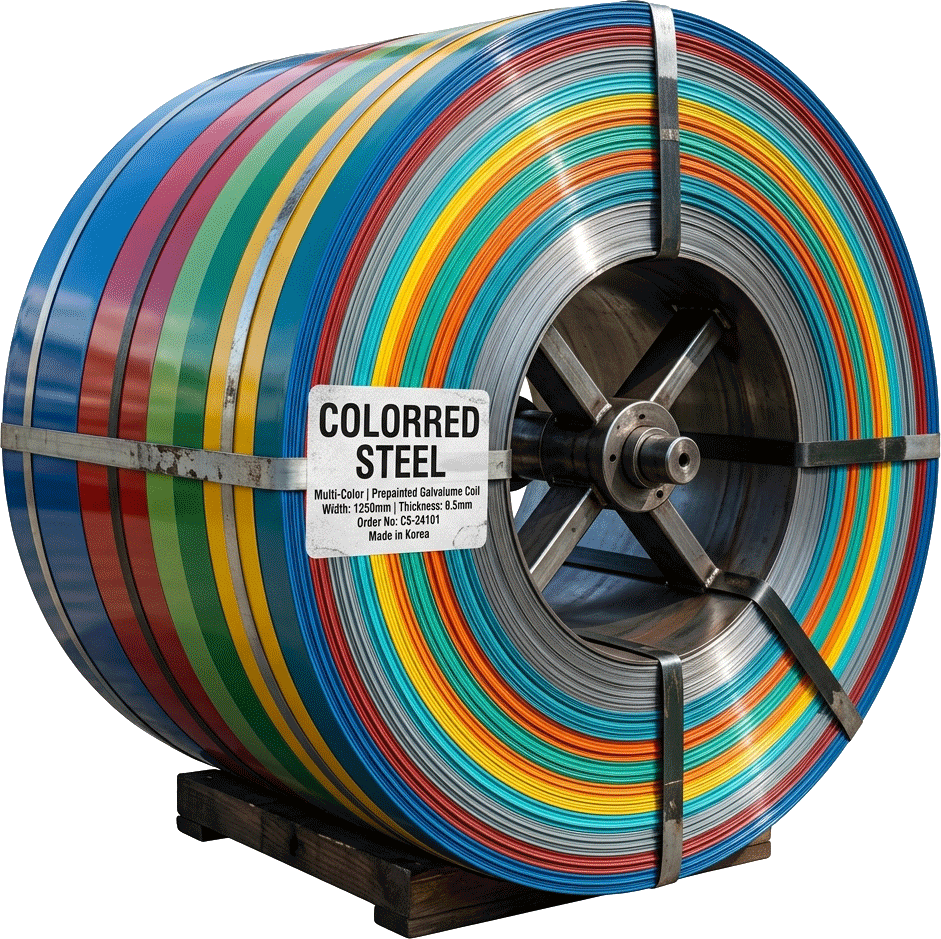
Colour coated coil — PPGI — is galvanised steel with a factory-applied paint system; on a Galvalume substrate the same product is called PPGL. In Pakistan it goes into roofing, wall cladding, sandwich panel, rolling shutters, false ceilings and appliance panels. Prime is commonly specified at 0.50 mm and 0.60 mm at 1219 mm width in RAL 9016; stock lot covers 0.20 mm to 0.80 mm in assorted colours.
Sizes Available:
Pre-painted galvanized iron (PPGI) is the go-to material for architectural roofing, cladding, and appliance panels across Pakistan. Raw Easy Corp is a leading PPGI importer, offering an extensive colour range, coating options, and gauge specifications, with full colour, coating and gauge specifications for contractors, fabricators and manufacturers.
| Attribute | Range / Standard |
|---|---|
| Product | Pre-painted galvanized iron (PPGI), colour coated coil |
| Prime thickness | 0.50 mm and 0.60 mm |
| Prime width | 1219 mm |
| Prime colour | RAL 9016 (traffic white) |
| Stock lot | 0.20 mm – 0.80 mm, assorted colours |
| Paint standards | EN 10169, with the EN 13523 test series |
| Substrate | Hot-dip galvanized or Galvalume, to EN 10346 / ASTM A653 / ASTM A792 |
| PCT heading | 72.10 |
Colour coated coil from China has been subject to anti-dumping duty since 2018. Duty exposure on this product can therefore change between order and arrival — confirm the position at the time you commit.
On a coil-coating line the strip is cleaned, chemically pre-treated, primed, top-coated and oven-cured in one continuous pass. Colour, film thickness and bend performance are fixed at the mill, not afterwards, which is the difference from a galvanised sheet painted on site where adhesion depends on preparation and humidity.
The paint is not the last line of defence, though — the zinc underneath is what protects the steel once the film is breached. That is why the coating class matters as much as the shade, and why the same scratch behaves differently on a light coating than on a heavy one.
| System | Relative cost | Where it belongs | What tends to go first |
|---|---|---|---|
| Polyester (PE) | Lowest | Interiors, ceilings, rolling shutters, short-life outdoor work | Chalking and fade, soonest in strong reds, oranges and bright blues |
| Silicone modified polyester (SMP) | Moderate premium | Industrial roofing that has to keep its colour for some years | Gloss dulls before the colour shifts; chalks later than PE |
| PVDF (PVF2) | Highest | Facades, visible cladding, coastal exposure | Surface marking in handling; ask for resin content, as “PVDF” is quoted on 70% and on lower-resin blends |
At specification grade all three are commonly built to roughly 25 microns nominal on the top side, so the name on the invoice is not what decides how long the sheet lasts. Resin chemistry, the zinc class beneath and the exclusions in the mill’s paint warranty do — see our comparison of PE, SMP and PVDF.
Settle prime versus stock lot at the enquiry stage: prime is first-quality mill material to a named RAL colour, while stock lot is mixed-colour surplus, priced accordingly and unsuitable where colour has to match across a roof. Ask for the mill test certificate either way — our guide to reading a coil MTC covers what to check.
Most of it goes onto roofs, roll-formed by profilers into single-skin sheet for factories, warehouses, godowns and sheds — that form is covered on our corrugated roofing sheet page. Then cladding and fascia, where PVDF or a good SMP earns its cost because the surface is at eye level. Sandwich panel is another use: PPGI skins on a PU, PIR or EPS core for cold stores, food and pharma halls and site offices.
Karachi adds a local complication: salt-laden humid air, a heavy monsoon, and coils that sweat inside a container at the port. That is how wet-storage stain — white rust — forms on the zinc surface wherever moisture is trapped between coil wraps or stacked sheets, and it is why coating class and storage practice matter more here than inland.
Colour coil is bought by weight and used by area, which is why a per-tonne rate and a per-foot sheet quotation are hard to hold against each other. The arithmetic is simple: base steel weighs its thickness in millimetres multiplied by 7.85 kg per square metre, and the zinc and paint add roughly another 0.15 kg. At 1219 mm width that gives:
| Thickness | Approx. weight | Flat area per tonne | Coil length per tonne | Roof covered per tonne after roll-forming |
|---|---|---|---|---|
| 0.50 mm (26 gauge) | 4.1 kg/m² | 244 m² (about 2,625 sq ft) | 200 m (656 ft) | about 200 m² (2,150 sq ft) |
| 0.60 mm (24 gauge) | 4.9 kg/m² | 204 m² (about 2,195 sq ft) | 167 m (549 ft) | about 167 m² (1,800 sq ft) |
The last column assumes roughly 1000 mm of effective cover from 1219 mm of coil, which is the usual order of loss on a single-skin corrugated profile; confirm the cover width of the profile being used, because it moves the figure directly. Divide the per-tonne rate on our steel rate list by that last column and you have a number you can compare with a per-foot sheet quotation.
Origin changes the landed cost, sometimes by more than the mill price difference that made an origin look attractive in the first place. Colour coated coil of Chinese origin has carried anti-dumping duty since 2018, charged ad valorem on the assessed customs value in addition to customs duty and additional customs duty. Because sales tax and advance income tax are then calculated on a value that includes those duties, the real cost of the anti-dumping duty is more than the headline percentage.
The substrate matters too. Chinese-origin Galvalume carries a flat 40.47% anti-dumping duty as an anti-circumvention measure notified to run to February 2027, and Chinese galvanised coil carries mill-specific rates with a higher residual rate for exporters not named. Positions are reviewed and amended, so confirm where your PCT heading stands on the day you commit — the specifications table on this page carries the heading for this product, and our summaries cover the Galvalume anti-dumping duty and the anti-dumping duty on galvanised steel.
Settle the fields in the list above before you enquire and the material can be priced without going back and forth. Say what it is for as well, because a rolling shutter, a cold-store panel and a coastal roof pull the specification in different directions, and the right answer to one is the wrong answer to another. Call Raw Easy Corp on +92 314 3279729 or use our contact page; the rest of the range is on our flat steel supply page.
Yes. PPGI, pre-painted galvanised iron, colour coated coil and pre-painted steel all describe the same product. Where the substrate is Galvalume it is often called PPGL, and it is specified the same way.
Two decisions, and the substrate is the bigger one. Karachi is coastal, so for an exposed roof specify PPGL — colour coated over a Galvalume (AZ) substrate — or, if it has to be galvanised, treat Z275 as the floor rather than the aspiration. On paint, SMP is the usual working choice for an industrial roof that has to hold its colour, and PVDF where appearance justifies the cost; PE is normally kept for interiors and short-life work. Do not fund the paint by dropping the zinc class. Galvalume substrate is covered on our HESHE Galvalume page.
At 1219 mm width, a tonne of 0.50 mm colour coated coil is about 244 square metres of flat sheet, roughly 2,625 square feet. Once it is roll-formed into a single-skin roofing profile the effective cover falls to about 1000 mm from 1219 mm of coil, so the same tonne covers about 200 square metres, roughly 2,150 square feet. Confirm the cover width of the profile being used, because it moves the figure directly.
No. RAL fixes the target shade, but batches from different mills, paint suppliers or production runs can differ visibly, and sheets already on a roof will have weathered. Order one roof or elevation in a single lot, and ask for a physical sample.
For anything exposed, yes. The factory film is cured at a controlled temperature and testable to the EN 13523 methods, and its T-bend rating under EN 13523-7 tells you how tight a bend it will take before the film cracks, while site paint usually fails first at fixings and cut edges. For local repair of an exposed galvanised coating, ASTM A780 sets out the methods.
Almost always because they are not the same product. Check the coating class, the paint system and its micron thickness, whether 0.5 mm is base metal or total coated, whether it is prime or stock lot, and the origin — origin decides the duty exposure, and on some origins that moves the landed cost more than the mill price difference does.
