Steel Coil Importers & Distributors
Local & International GP
CRC-HRC-GP-ZAM-HESHE-PPGI
Steel Coil Importers & Distributors
Local & International GP
CRC-HRC-GP-ZAM-HESHE-PPGI
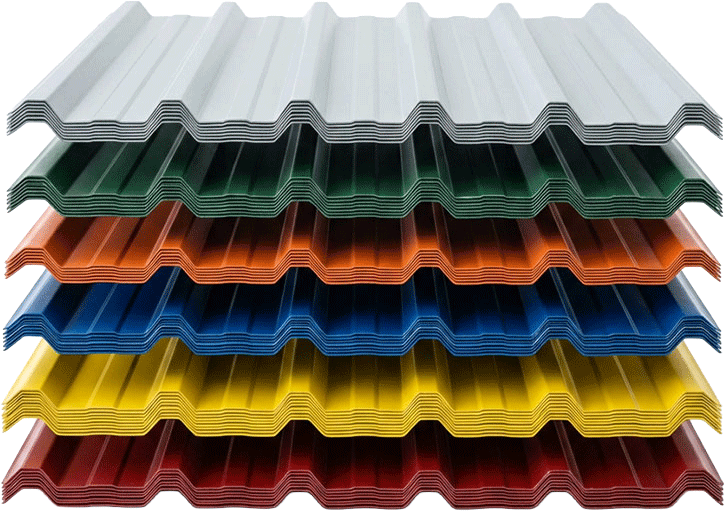
Corrugated steel sheets are widely utilized for roofing, siding, and agricultural buildings. Standard specifications feature wavy profiles alongside thicknesses from 0.15 to 1.2 millimeters, ensuring excellent structural strength and durability
Sizes Available:
Raw Easy Corp supplies corrugated steel sheets for roofing and cladding projects across Pakistan, roll-formed from galvanised and colour-coated coil. Popular with contractors and industrial buyers for their durability and weather resistance, our corrugated sheets are available in standard profiles with fast turnaround from our Karachi facility.
| Attribute | Range / Standard |
|---|---|
| Product | Corrugated roofing and cladding sheet |
| Thickness | 0.30 mm – 0.80 mm |
| Maximum length | 20 ft |
| Profiles | American profile and Gol Nali |
| Substrate | Galvanized (GP) or colour coated (PPGI) coil |
| Coating standards | JIS G3302 / ASTM A653 for galvanized; EN 10169 for painted |
| PCT heading | 72.10 |
Corrugated sheet is flat coil roll-formed into a profile. In Pakistan the two common profiles are the American profile and Gol Nali, and sheets are ordered by profile, thickness and length rather than by weight.
Two things decide how long a corrugated roof lasts, and neither is the profile. The first is the zinc or aluminium-zinc coating mass on the substrate; the second is whether the sheet is painted and with what system. Our zinc coating guide and paint systems comparison cover both, and the gauge chart converts the gauge numbers the market quotes into millimetres.
Duty exposure follows the substrate and its origin, not the corrugation. Chinese galvanized and colour coated coil both carry anti-dumping duty; locally produced coil does not.
Corrugated sheet is priced from the coil it is rolled from, so the rate moves with the flat steel market and the rupee. On any given day, a sheet’s price is set by five things: the substrate (plain galvanized GP or colour coated PPGI), the thickness — a 0.50 mm sheet simply carries more steel per foot than a 0.30 mm sheet — the zinc coating mass, the coil brand and origin with its duty treatment, and the sheet length. Quotes are per kg, converted to per-sheet once the size is fixed.
Because the coil market moves, any published number goes stale quickly. Current coil rates are on our steel rate list page — call for a firm per-sheet quote for your gauge and length. Roof sheet prices in Karachi follow the same drivers, with delivery available across Pakistan.
Plain galvanized corrugated sheet — the roofing patra on most sheds, warehouses and boundary walls — is the workhorse: the zinc layer protects the steel, and heavier coatings last longer. PPGI colour coated sheet adds a factory paint system over the same galvanized base for appearance and an extra barrier; paint families differ widely in durability, as explained in our PPGI paint systems guide. Bare galvalume (AZ150) sheet is the third option in the market, with longer bare-sheet corrosion life but a higher landed cost — see the galvalume duty guide for why. For a fuller comparison, read PPGI vs GI vs Galvalume for roofing.
In Karachi’s coastal air, storage matters as much as the coating: sheets stacked wet can stain within days. Our white rust guide covers receiving and storage practice.
Sheets are supplied in American profile and Gol Nali, rolled from GP and PPGI coil in thicknesses from 0.30 mm to 0.80 mm, in lengths up to 20 ft. The local market still quotes roofing thickness in gauge numbers; the mapping from SWG to millimetres — and why the same “gauge” can mean two different thicknesses — is in our gauge-to-mm chart. When comparing quotes, confirm thickness in millimetres BMT — base metal thickness, the steel on its own — rather than TCT, total coated thickness, which counts the zinc in.
It moves daily with coil rates and the rupee. Sheets are quoted per kg by substrate, thickness, coating and length — see the per-ton coil rates on our rate list page, or call for a firm per-sheet quote.
Most residential and commercial roofing in Pakistan uses sheet between roughly 0.30 mm and 0.50 mm, moving thicker for long spans, foot traffic or high wind; industrial cladding runs up to 0.80 mm. Always confirm the millimetre thickness rather than the gauge number alone.
Both share the same galvanized steel base. PPGI adds a factory-applied paint system for appearance and an extra corrosion barrier; both roll into the same profiles.
American profile and Gol Nali, 0.30 mm to 0.80 mm thickness, lengths up to 20 ft, from galvanized or colour coated coil.
Yes — patra is the everyday name for a metal roofing sheet in Pakistan, most often plain galvanized corrugated sheet. Contact Raw Easy Corp for stock and rates.
Buying roofing sheet locally? See our Karachi steel supplier page.
A corrugated profile is described by two dimensions: pitch, the distance from one crest to the next, and depth, the height from trough to crest. Between them they decide how stiff the sheet is, how far it spans between purlins, and how much flat coil is consumed to make it. The two names used on this market, American profile and Gol Nali, are applied loosely from one roll-forming shop to the next, so ask for pitch and depth in millimetres as well as the name.
The measurement that decides an order is cover width. Overall width is the sheet measured edge to edge; cover width is what remains once the side lap corrugation has been taken up by the next sheet. On a single-corrugation lap the difference is one full wave, and it multiplies across the building. Ten sheets at a 3.5 ft cover width close 35 ft of length; measured overall the same ten look like more.
Depth carries a cost that is easy to miss. A deeper profile is stiffer and tolerates wider purlin spacing, but it swallows more flat width in the corrugation itself, so a given coil width yields less cover. Compare quotes per covered square foot rather than per sheet.
Thickness and coating do different jobs, and buyers routinely trade away the wrong one. Thickness buys stiffness: span between purlins, resistance to denting, survival during handling and fixing. Coating buys life, and extra thickness does not compensate for a thin coating — a heavier gauge lightly coated will often be perforating around the fastener holes while a lighter gauge in a proper coating class is still intact. That gap widens on the coast, and imported coil that has sweated inside a container at the port starts its service life already behind. Specify coating mass deliberately rather than accepting whatever a sheet happens to carry: our zinc coating guide explains what the Z-numbers mean, and our white rust guide covers receiving and stacking.
Colour coated PPGI puts a factory paint system over a galvanised or Galvalume base; the paint systems guide sets out how PE, SMP and PVDF differ in service life. Paint does not protect the cut edge, where only the zinc is working, so a painted sheet on a thin coating is still a thin-coating roof.
Roofs rarely leak through the sheet. They leak at the side lap, the end lap and the fastener, so the fixing detail deserves more attention than the mill name on the coil.
Side lap is normally one corrugation, taken to two on exposed sites and on pitches below about 10 degrees, and the runs should be laid so the laps face away from prevailing weather. End laps come in whenever the slope run is longer than one sheet: the sheets overlap along the slope, always over a purlin so both leaves are fixed through the same line. The steeper the roof, the shorter that lap can safely be; on a shallow pitch, lengthen it and bed it with butyl sealant tape, because at low slope water moves by capillary action between the leaves and travels uphill against gravity. Below about 5 degrees, lapped corrugated sheet is the wrong product and the roof wants a system designed for that pitch.
Purlin spacing follows profile depth, sheet thickness and the load the roof carries, including foot traffic during fixing. A 0.30 mm sheet set out at the spacing suited to 0.50 mm will flex and dent underfoot even though nothing has corroded. Fasteners go on the crest, not in the trough where the screw would sit in running water; on a deep trapezoidal profile, follow the fixing detail that profile is designed for. Use self-drilling screws with bonded EPDM washers and tighten only until the washer just spreads, since over-tightening dimples the crest and crushes the washer. Sweep drilling swarf off the same day, as the filings rust in place and stain the coating. Sheared edges need no touch-up, since the surrounding zinc protects them sacrificially; make good site damage where the coating has been scraped through, in line with ASTM A780.
Counting sheets is simple arithmetic once the cover width is known, and worth doing before asking for a quotation.
Corrugated sheet is bought by weight, so the last step is converting sheets into kilograms. Base steel weighs 7.85 kg per square metre for every millimetre of thickness. The gauge column below follows the Karachi trade chart, and other charts read the same number thicker, so specify millimetres rather than a gauge number. The two right-hand columns assume a sheet that covers 3.5 ft, rolled from about 4 ft of flat coil; check that blank width against the profile you are actually buying, because a deeper profile consumes more.
| BMT (mm) | Karachi trade gauge | kg per m² flat | kg per ft² flat | kg per 10 ft sheet, 3.5 ft cover | kg per m² of finished roof |
|---|---|---|---|---|---|
| 0.30 | 30 | 2.36 | 0.219 | 8.75 | 2.69 |
| 0.35 | 29 | 2.75 | 0.255 | 10.21 | 3.14 |
| 0.40 | 28 | 3.14 | 0.292 | 11.67 | 3.59 |
| 0.45 | 27 | 3.53 | 0.328 | 13.13 | 4.04 |
| 0.50 | 26 | 3.93 | 0.365 | 14.59 | 4.49 |
| 0.60 | 24 | 4.71 | 0.438 | 17.50 | 5.38 |
| 0.70 | 23 | 5.50 | 0.511 | 20.42 | 6.28 |
| 0.80 | 22 | 6.28 | 0.583 | 23.34 | 7.18 |
The two right-hand columns are the ones that decide an order. A sheet sold as 3.5 ft covers 3.5 ft but is rolled from about 4 ft of flat coil, so it weighs as though it were 4 ft wide — roughly 14 per cent more steel than the covered area suggests, and the gap widens with a deeper profile. That is also why a flat sheet 3.5 ft wide and a corrugated sheet covering 3.5 ft are not the same weight, and why the flat-sheet figures in our gauge-to-mm chart read light for a corrugated roof. Then add the coating: about 0.08 kg per square metre for Z80 and 0.275 for Z275, which on a 0.30 mm sheet is between three and twelve per cent of the base weight. You buy the zinc by weight along with the steel, which is one reason a heavier coating class costs more per square foot of roof.
Take the covered area of the roof, multiply by the kilograms per square metre of finished roof, add five to ten per cent for laps and wastage, and the result is the coil weight the quotation is built on.
With those four, a per-kg rate converts to a firm per-sheet figure. Contact Raw Easy Corp with the details and we will quote against them.
Divide the eave length of each roof plane by the cover width of the profile, not the overall sheet width, and round up. Then check the slope length from ridge to eave against the sheet length: anything longer than one sheet needs an end lap, and the lap is added to the slope measurement rather than absorbed into it. Allow five to ten per cent for wastage and damage, and count ridge cap, flashings and fasteners separately.
A 10 ft sheet covering 3.5 ft weighs about 14.6 kg in 0.50 mm and about 8.8 kg in 0.30 mm before the coating, which adds a little more. Weight follows the flat width the sheet is rolled from, not the width it covers, and a sheet covering 3.5 ft is rolled from about 4 ft of coil. Multiply the covered area of the roof by the figure in the weight table, add five to ten per cent for laps and wastage, and that is the coil weight your quotation is priced from.
On the crest, using self-drilling screws with bonded EPDM washers, tightened only until the washer spreads. A fastener in the trough sits in the path of running water, and an over-tightened one on the crest dimples the sheet and crushes the washer. Leaks usually trace back to fasteners and laps rather than to the sheet itself.
Because it is priced from the coil it is made from, and coil trades by weight. A sheet’s weight follows its flat developed width, its length and its thickness, so a per-sheet figure exists only once profile, thickness, coating and length are fixed. A deeper profile consumes more flat width for the same cover, which is why two sheets of the same thickness can differ in weight and in cost per covered foot.
