Pakistan’s Steel Market Has a Trust Problem: Dealers Buy on Price Increase Signals, Mills Announce Fresh Cuts
By Raw Easy Corp | November 2, 2026
Pakistan’s flat steel market is facing a crisis that goes beyond falling prices and inventory losses. A growing number of dealers and buyers are questioning whether they can still trust the pricing signals coming from the country’s major steel mills.
In a market where purchasing decisions involve millions of rupees and substantial working capital, confidence is everything. Dealers depend on mill price indications to decide when to purchase, how much inventory to maintain and what rates to offer their customers.
But the latest developments have left many market participants feeling misled.
Dealers Were Expecting an Increase. Instead, They Got Another Price Cut.
According to market feedback, dealers had been receiving indications from International Steels Limited (ISL) that prices were expected to increase. Taking these indications into consideration, a number of dealers proceeded with purchases, expecting the market to strengthen.
The expectation was straightforward: if mill prices were going up, holding inventory or purchasing additional material would be a reasonable commercial decision.
However, the market took a completely different turn.
Aisha Steel announced another substantial price reduction, cutting CRC prices by approximately Rs. 6,000 per ton and galvanized coil prices by Rs. 8,000 per ton, effective November 1, 2026.
The announcement immediately changed market economics.
Dealers who had purchased material at higher prices suddenly found themselves facing depreciating inventory, while buyers who had delayed their purchases were now in a position to negotiate at lower rates.
For businesses operating on relatively thin trading margins, such movements can wipe out the profit from several transactions.
The Real Damage Is Not Just Financial. It Is a Loss of Confidence.
A dealer can absorb an occasional market correction. Steel prices fluctuate internationally, exchange rates change, and mills have every right to revise their selling prices.
But what happens when dealers purchase material based on indications of an expected increase, only to face another major price reduction shortly afterwards?
This is where the damage becomes much deeper.
Market feedback suggests that dealers are increasingly expressing frustration with the pricing communication coming from both major local mills.
Some market participants are now openly saying that they have lost confidence in mill price indications and will no longer make purchasing decisions simply because they are told that prices are expected to increase.
This represents a significant change in market psychology.
Previously, a positive indication from a major mill could encourage dealers to replenish inventory and support market activity. Now, buyers may prefer to wait for an actual price notification rather than rely on verbal indications or market expectations.
When dealers stop trusting the price signals of mills, the entire distribution chain begins to change.
Aisha’s Price Reduction Has Exposed the Risk of Buying on Expectations
Aisha Steel’s latest reduction has once again highlighted the risks of purchasing inventory based on anticipated price movements rather than confirmed market rates.
The immediate beneficiaries are buyers who can now procure material at lower replacement prices.
But the impact on existing inventory holders is substantial.
Consider a dealer who purchased 100 tonnes of material expecting a price increase. Even a reduction of Rs. 8,000 per ton represents a potential inventory value impact of Rs. 800,000, before considering other costs.
For a dealer carrying 500 tonnes, the same price movement translates into Rs. 4 million in potential inventory exposure.
These are not small adjustments for businesses operating in a competitive, low-margin trading environment.
The situation is particularly difficult for importers, whose landed costs are determined by international prices, freight, duties, taxes and currency movements. Domestic mill reductions can push local replacement prices below the importer’s actual landed cost, creating an undercost market.
For further context, read our earlier analysis: GP Price War in Pakistan: ISL and Aisha Steel Cut Rs. 21/kg.
Dealers May Change the Way They Buy Steel
Perhaps the most important consequence of this episode will be how dealers behave in the coming weeks.
If market participants no longer consider mill price indications reliable, purchasing behaviour could change significantly.
We may see:
* Dealers reducing inventory levels and avoiding speculative purchases.
* Buyers demanding confirmed written prices before committing to large orders.
* Distributors becoming more cautious about purchasing directly from mills.
* Importers becoming increasingly hesitant to commit capital to long shipping cycles.
* End users delaying procurement until actual price movements become clearer.
This could create a market where even positive price indications fail to generate the buying activity that mills traditionally expect.
A price increase announcement is only effective when the market believes it.
The Bigger Issue: Trust Takes Years to Build and Moments to Lose
Pakistan’s flat steel industry depends on a strong relationship between manufacturers, importers, dealers, distributors and end users.
Local mills are important to the country’s industrial supply chain. Their distribution networks are equally important in ensuring that manufacturers, fabricators and smaller buyers receive material consistently.
However, a sustainable market requires more than competitive pricing.
It requires predictable commercial communication, transparency and confidence that market participants can make purchasing decisions without repeatedly being caught off guard.
The issue is not whether ISL or Aisha Steel should increase or decrease prices. Both mills must remain free to respond to international raw material costs, demand and competitive conditions.
The concern is the widening gap between market expectations and actual price announcements, and the financial consequences for businesses that rely on those expectations.
Raw Easy’s View: The Market Will Remember This Episode
The latest price developments have delivered a serious blow to confidence in the domestic flat steel market.
Dealers who purchased expecting an increase are now facing another price correction. Importers are struggling against domestic replacement prices below their landed costs, and buyers are becoming increasingly cautious.
The most important question is no longer simply where steel prices will go next.
It is whether dealers will continue trusting the market indications coming from local mills.
A financial loss can eventually be recovered through future business. But rebuilding confidence across an entire dealer network is considerably more difficult.
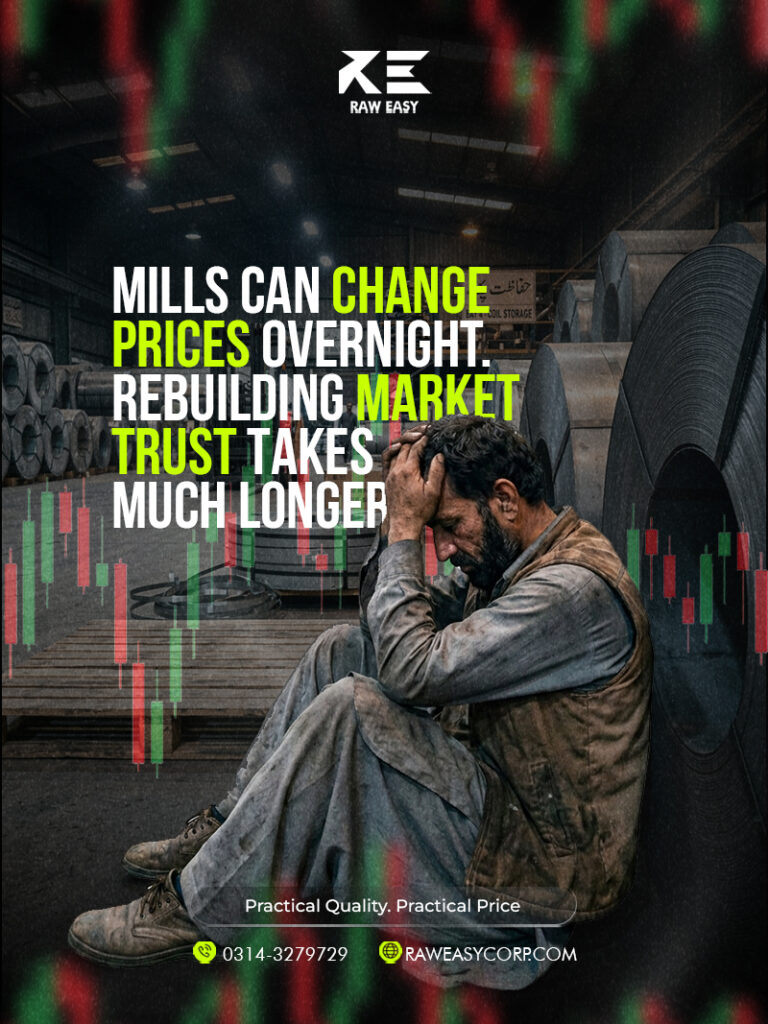
Mills can change their prices overnight. Rebuilding market trust takes much longer.
And perhaps the biggest lesson from this episode is that, going forward, dealers may trust actual price notifications more than promises of an expected increase.
⸻
About Raw Easy Corp
Raw Easy Corp is a Pakistan-based flat steel importer and trading house supplying HRC, CRC, GP, PPGI, Galvalume and ZAM products to manufacturers, fabricators, distributors and industrial buyers across Pakistan.
For steel market updates, product information and current rates, visit www.raweasycorp.com.